
Written by: Arthur, Founder & CEO of ISFM
Introduction
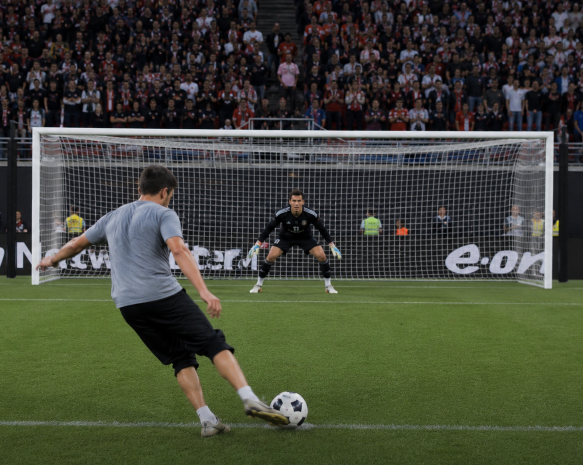
Imagine you standing on the penalty spot in front of a professional goalkeeper, with thousands of fans watching.
All you have to do is score once.
Sounds possible…right?
But how difficult is it really?
How good would an “Average Person” be?
Well, to make it fair, an “average person” would most likely have the following traits:
- Not necessarily athletic, but can be,
- Doesn’t have any professional experience in soccer whatsoever,
- Probably plays soccer as a casual hobby
With that stated, you can probably shape the most Average Person possible to take that kick.
Statistically, what are the odds of success?
Well first of all, let’s break it down:
- A top-class, elite professional soccer player has approximately a 76–85% chance of scoring a penalty. This means that an elite professional goalkeeper successfully prevents a goal roughly 15–24% of the time, either by saving the shot, forcing a miss, or benefiting from poor placement.
- This statistic already includes all real-world factors: goalkeeper anticipation, reaction time, positioning, shot power, shot placement, and player composure under pressure.
This means that if the average person described earlier were to take the place of a top-class, elite soccer player, their odds of scoring would be significantly lower for the following scientific reasons:
- A professional goalkeeper can launch their body and cover much of the goalmouth in roughly 0.6–0.7 seconds, depending on positioning and dive direction. Meanwhile, a casual, moderately athletic person generally produces a shot velocity between 40–45 mph (64–72 km/h). At this speed, the ball takes roughly 0.55–0.70 seconds to reach the goal from the penalty spot.
- Because the shot travels slower than a professional-level penalty (typically 70–80 mph / 112–129 km/h), the goalkeeper has more time to visually identify the ball’s direction and react. Elite outfield players shoot so quickly that goalkeepers are often forced to commit before or exactly at ball contact. At professional speeds, keepers effectively have only around 0.10–0.20 seconds to adjust after reading the shot, making reactive saves extremely difficult.
This is why professional goalkeepers often commit to one of three broad zones before the shot is fully struck:
- The left side of the goal
- The right side of the goal
- Staying central (to defend against a chipped penalty, such as a Panenka)
However, unlike against elite shooters, an average person’s slower shot gives the goalkeeper more time to recognize where the ball will land, and react mid-dive or even delay committing entirely. This really increases the goalkeeper’s chances of making a save.
More importantly, penalty success is not determined by power alone, placement is the largest factor. To consistently beat an elite goalkeeper, the shooter generally needs to place the ball into extremely difficult-to-reach areas of the goal: the low side netting, upper corners, or other high-difficulty “unsavable” zones.
The problem for an average person is accuracy under pressure.
Mathematical modeling of amateur shot mechanics suggests that when casual players attempt to place penalties into these extremely tight corners, their consistency drops dramatically. Many either:
- Strike the ball too centrally (making it saveable),
- Reduce power to improve accuracy (giving the keeper more reaction time), or
- Miss the target entirely while attempting difficult placement.
A realistic breakdown of outcomes for an average, casual soccer player facing an elite goalkeeper might look like this:
Missed entirely: 0%
The shooter aims too aggressively for a corner and sends the ball wide or over the crossbar.
Saved comfortably: ~5–10%
The ball is on target but struck too centrally, too slowly, or without enough precision to beat an elite keeper.
Difficult but scoreable placement: ~10–20%
The shooter finds a strong lower corner or side netting with decent pace, creating a legitimate scoring opportunity.
Nearly unsavable shot: ~20–30%
The shooter perfectly executes an exceptional placement into the extreme corners of the net.
Putting these probabilities together produces a realistic estimated scoring chance of roughly:
10–15% scoring chance per penalty
for an average person with no professional soccer experience facing a truly elite goalkeeper.
Those were all of the factors to finding the odds of scoring. Find where you stand in the table below:
| Takes ~20 shots (~5% success): | If the person is less athletic, nervous, or lacks ball striking experience. |
| Takes ~7–10 shots (10–15% success): | Most attempts are saved or missed, but every so often the shooter successfully places the ball tightly enough into a corner to score. |
| Takes ~4–5 shots (~20–25% success): | If the person plays soccer regularly and has strong natural accuracy. |
Conclusion
With a lot of research and time, ISFM has gathered all of the right material for this article. If you found your place in the table, don’t hesitate to comment where you stand. (How many shots you need) We really hope we answered your questions in this article, and we hope you learned something new!
Thank you for reading this article!
If you would like to buy someone in need a meal, click here. We donate 20% of our yearly donations to St. Anthony’s homelessness organization, and keep the other 80% to grow our website.
Every transaction matters. Every donation matters. Your support can put a starving, jobless person back on their feet.
Written by: Arthur, Founder & CEO of ISFM

Leave a Reply