
Written by: Mateo, Reporter at ISFM
Introduction
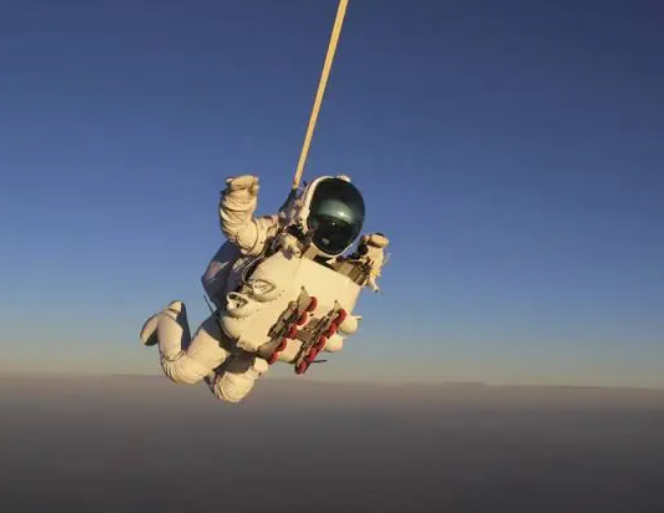
On October 24, 2014, after ascending to an altitude of 41,422 meters (135,898.68 feet) above Roswell, New Mexico, USA, attached to a helium-filled balloon, Google Senior Vice President Alan Eustace (USA) was released to set a new exit altitude record, verified by the Fédération Aéronautique Internationale (FAI) on April 14, 2015.
Imagine something more than 50 times taller than the world’s tallest tower, which is 828 meters tall!!!
The view from up there
At over 41,000 meters, Alan Eustace saw the Earth from an incredible perspective. The clouds looked like a white carpet, and the Earth was visibly curved. The sky was almost black, with stars visible.
From up there, the world seemed calm and very small. A unique moment, just before his spectacular jump.
What does 41,422 meters high represent?
That’s about four times higher than a commercial airliner, which flies at around 10 to 11 km.
It’s almost five times the height of Mount Everest (8,849 m).
We are very close to space, which begins at around 100 km altitude.
At this height, the air is very thin and the temperatures are extremely low.At an altitude of 41,422 meters, the temperature is approximately between –10 °C and –30 °C. We are in the stratosphere.
The Outfit
At an altitude of 41,422 meters, the outfit must protect against extreme cold, lack of oxygen, and very low pressure.
Here is the outfit used:
Pressurized suit: It replaces air pressure to prevent the body from being in danger.
Airtight helmet with oxygen supply
Oxygen system for breathing
Thermal protection against intense cold
Insulated gloves and boots integrated into the suit
Parachute and safety systems
Anecdotes
Alan Eustace reached a maximum speed of approximately 1,322 km/h during his freefall, which is faster than the speed of sound.
That’s faster than a Formula 1 car (approximately 350 km/h),
faster than a high-speed train (320 km/h),
and faster than a commercial airliner (900 km/h).
Paris to Rome in 1 hour.
Like a fighter jet, but without an engine, just falling through the void.

Leave a Reply