
Written by: Mateo, Reporter in ISFM
Inroduction
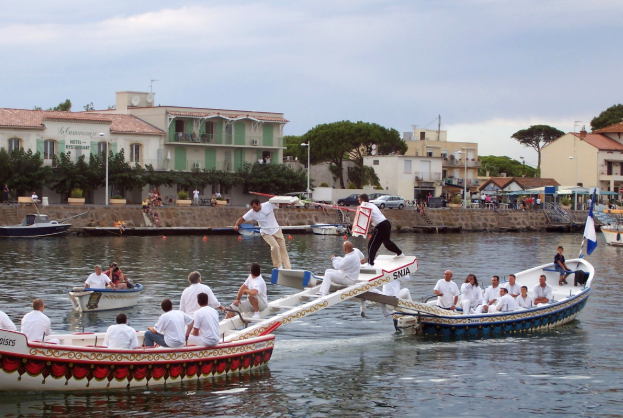
Two boats face each other and move towards each other, propelled by rowers.
At the back of each boat is a “tintaine,” a raised platform.
On this platform, a player called a jouster stands, equipped with:
- a shield,
- a lance (usually made of wood).
The objective is to knock the opposing jouster into the water upon impact between the two boats.
Where is this sport practiced?
Water jousting is often associated with local festivals, such as the Saint-Louis festival in Sète, France, one of the most well-known tournaments.
It is accompanied by traditional music, particularly the peña (brass band), and attracts many spectators.
Origins
Forms of jousting on water existed in antiquity, particularly among the Egyptians, Greeks, and Romans.
In France, the first written records of nautical jousting date back to the Middle Ages!
The Boats
They are often painted in two colors: blue and red, to differentiate the teams.
Each boat bears a traditional name.
Balance is crucial: too much movement and the jouster falls before impact.
Actual boat names:
The Anchovy
The Sea Bream
The Mullet The Octopus
The Sardine
The Tuna
Muikka
Some Famous Jousters
The following are some famous jousters.
Jean-Marie Rouquette
Legend of Languedoc jousting.
Won numerous Saint-Louis tournaments in Sète.
Known for his power and consistency.
Jean-Michel Defferrard
One of the most decorated jousters.
Highly respected for his technique.
Jean-Paul Parayre
An iconic figure in the 1980s and 90s.
Appreciated for his style and precision.
Franck Castanier
Several major titles.
A renowned jouster in Sète and throughout the region.
Younger Recent Champions
Every year, new talents emerge in the youth categories (cadets, juniors).
The clubs of Sète, Agde, Frontignan, and Mèze train many promising jousters.
Thank you for reading!
Written by: Mateo, Reporter in ISFM


Leave a Reply