
Written by: Arthur, Founder of ISFM
In this article, we’ll be talking about…wait a minute…Skiing in the middle of summer? That’s right! We’ll be talking about Roller Skiing.
Introduction
Roller Skiing is a sport not many people know about. I just recently discovered about roller skiing when I was looking outside my car window, and I saw this man riding skis, but with wheels on them. I really wondered what it was, so I did some research. I was really excited after I learned about it, so I decided to share my discovery with you guys.
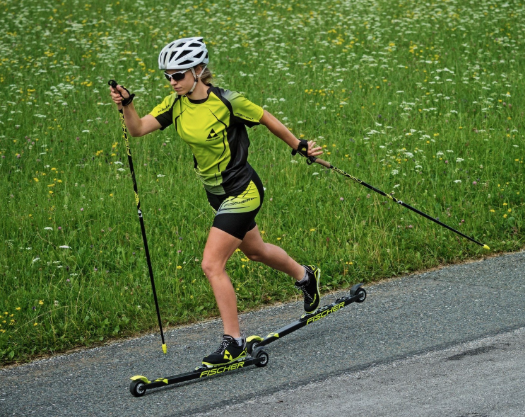
Roller skiing, to explain it in a simple manner, is cross-country skiing, but on wheels. The whole point of the sport is to train ski athletes when it doesn’t snow, so when they are competing, they are well-trained. Roller skiing replicates nearly perfectly the same movement as the real thing.
Roller skiing mostly focuses on keeping athletes sharp on performance, but also focuses on endurance, balance, and smooth techniques, all needed for pro snow skiing.
Gear/Equipment
A full-on roller ski setup includes a few key pieces; The skis are short, lightweight frames with two wheels. The poles are the exact same as the real deal, but the tips are specially designed for cement, and pavement. Athletes also wear special boots that click into place with bindings, allowing them to replicate the same boots as skis.
The wheels are special; the speed of them depends on the type of training. Slower wheels help build strength in the legs, and faster wheels are used for speed, and racing.

Historic Timeline
Roller Skiing began in the 1930s as a training method for cross-country skiers off-season, when there was no snow. AT first, the gear was heavy at the feet, and hard to control, but then it evolved over time into what it is today. Here is a timeline explaining the important milestones in roller skiing history.
- In the 1930s, Roller skiing was invented as a snow-free training method for cross-country skiers.
- Early equipment: Wooden boards with bicycle wheels; simple and heavy.
- Post WWII (Post Word War 2): Scandinavian athletes adopt roller skiing for serious off-season conditioning.
- In the 1970s, Modern roller skis emerged — lighter materials, safer bindings, narrower wheels.
- 1980s–1990s: Competitive roller-ski racing grows across Europe.
- Year 2000: International Ski Federation launches the first Roller Skiing World Cup.
- Today: Used worldwide as both a competitive sport and essential training tool for cross-country skiing.
Rules and How it works
Well, there aren’t actually any rules in roller skiing. Yes, you heard me, there are NO rules! All you have to do is get on the skis, just be sure to not get in any danger when riding.
Remember, this is a way of transport, so be attentive of your surroundings, and even more careful if you’re planning to cross streets.
As long as you have fun, do whatever you feel like doing!
Why Roller Skiing is not like any other sport
Roller skiing is special because it brings the feeling of skiing into places where snow doesn’t exist. It allows athletes to train on streets, park paths, or even closed circuits, keeping the sport alive year-round. It’s also accessible, since anyone with balance and coordination can pick it up fairly fast. The best part is, you can do it anywhere! Just bring your roller ski, and have fun!
The sport is a unique mix of speed, technique, and endurance, making it one of the best full-body workouts. Whether you’re training for winter races or just want a fun way to move, roller skiing offers something exciting and different.
Conclusion
Overall, roller skiing is probably one of the funnest hobbies you can have. If you already know how to ski, great! If you don’t, roller skis are the perfect gift for you! You’ll learn very quickly, (Hopefully without falling as much as with real skis) and one day, you’ll be ready for snow skiing!
Have fun, and treat yourself to a nice, new pair of roller skis. You deserve it!
Thank you for reading!
Written by: Arthur, Founder of ISFM

Leave a Reply