
In this article, we’ll be talking about the evolution of bicycles.
Written by: Arthur, founder of ISFM
Introduction
Imagine riding a nice trail in the mountains, or pedaling in between large buildings; that’s all thanks to the bicycle, or bike. But have you ever wondered where this marvelous invention comes from?
Well, in this article, we’ll explain everything you need to know about the history of cycling.
History
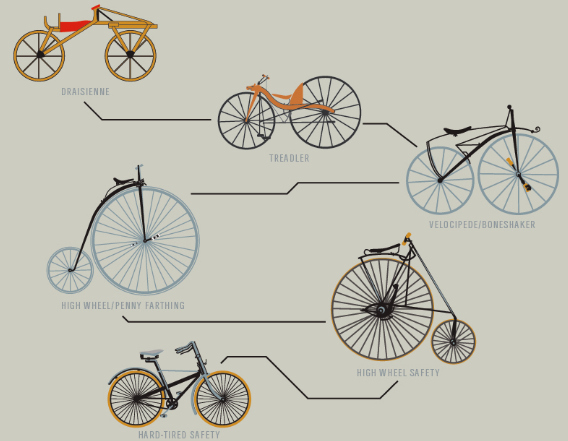
Bicycles were first introduced to the world in 1817 by German forest scientist Karl Drais. He named his invention the Draisine, or Laufmaschine. But the first blueprint of the bicycle had no pedals, and it was pushed by the rider’s feet.
In the 1860s however, (Around 45 years later) french inventors Pierre Michaux and Pierre Lallement added pedals to the forward wheel, creating a *velocipede.
Years went by, and a new design came forward; the “Penny-Farthing” bicycle. This model had a large front wheel and a smaller back wheel, giving it speed, but taking away safety and stability.
The 1880s was a new era for bicycles. A sturdy :”Safety Bike” was created. The design had two wheels of equivalent size, a chain drive, and brakes. This led to the modern bicycle design we have today.
Conclusion
I honestly think from where it all started, bikes took a major step forward, and helped us humans take a huge step forward, too. Whenever you see or ride a bike, you now know how they were made, who made them, and when they were made.
*Velocipede
A human powered land vehicle with one or more wheels.
Thank you for reading this article!
Hopefully you liked it, and learned some more. To help keep you informed, subscribe to ISFM for free to get new updates and new articles right in your inbox. If you know someone that will enjoy this article, please share it with them so they can relish this article too!
Written by: Arthur, founder of ISFM


Leave a Reply