
Written by: Camden, Reporter in ISFM
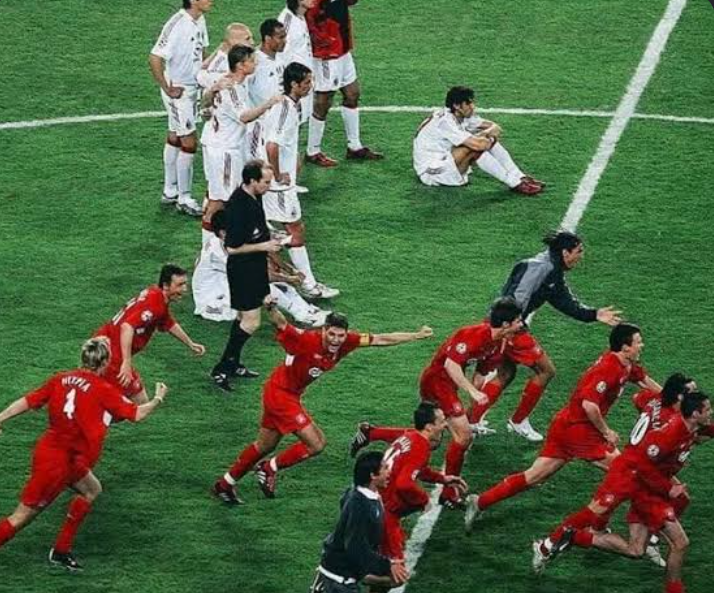
The 2005 UEFA Champions League final, played at the Atatürk Olympic Stadium in Istanbul, stands as the most dramatic comeback in football history. Known universally as “The Miracle of Istanbul,” the match on May 25, 2005, saw English club giants Liverpool (the underdogs of this story) pull off an impossible rescue mission against legendary AC Milan.
AC Milan entered the final as the favorites to win with Carlo Ancelotti as their manager. Their star-studded lineup was a collection of generational superstars, for example, players like Paolo Maldini, Clarence Seedorf, Nesta, Kaká, Cafu, and Shevchenko. Liverpool, on the other hand, was managed by tactician Rafael Benítez, who were the clear underdogs of this story. The vast gulf in class seemed immediately apparent as a ruthless Milan tore the English side apart in a devastating first-half performance.
Just fifty-two seconds into the match, Milan captain Paolo Maldini volleyed home a free kick delivered by Andrea Pirlo, scoring the fastest goal in Champions League Final history. Liverpool struggled heavily to contain the brilliant Brazilian playmaker Kaká, who effortlessly orchestrated Milan’s countless counterattacks.
The nightmare worsened in the 39th minute when Kaká drove forward and fed Shevchenko, who squared the ball perfectly for Crespo to tap in at the back post.
Just five minutes later, right before the whistle, Kaká produced arguably the pass of the tournament—a sublime, first-time curling ball that traveled half the length of the pitch to find a sprinting Crespo. The Argentine striker delicately chipped the ball over an advancing Jerzy Dudek, leaving Liverpool completely shell-shocked and down 3-0 at halftime.
What happened next in the dressing rooms became the stuff of legend. While some AC Milan players reportedly started celebrating, Rafa Benítez calmly executed a tactical masterclass. He substituted injured right-back Steve Finnan for defensive midfielder Dietmar Hamann, switching to a fluid three-man backline. Hamann’s job was simple: mark Kaká out of the game. This adjustment freed up Liverpool’s inspirational captain, Steven Gerrard, to push higher up the pitch.
Driven by the deafening chorus of “YOU’LL NEVER WALK ALONE” echoing from the traveling fans in the stands, Liverpool walked out for the second half a completely different team. In the 54th minute, John Arne Riise crossed to Gerrard, who guided a header into the top corner to make it 1-3. Gerrard waved his arms frantically, single-handedly igniting belief within his teammates and fans.
Just two minutes later, the impossible dream gained unstoppable momentum. Substitute Vladimir Šmicer collected and unleashed a low, powerful drive from twenty-five yards out that flew out past a diving Dida into the bottom corner, with the score now 3-2. Milan panicked, moving from celebrating in the locker room to now thinking that the impossible is now possible.
In the 60th minute, Gattuso brought down Milan Baroš in the penalty box, bringing up Liverpool’s chance of tying. Xabi Alonso is the one stepping up to take the deciding penalty. If he misses, then it is still 3-2 in favor of Milan, but if he scores, then Liverpool are about to make history with one of the biggest comebacks in Champions League history. Xabi stepped up and placed the ball on the penalty point and, though his initial shot was saved by Dida, Xabi sprinted up and shot the ball into the back of the net to bring the score level and make the score now 3-3 in a breathless six-minute window.
Liverpool had a double-save from Dudek against a thunderous, point-blank shot from Shevchenko. Dudek’s subsequent mind games routine (“spaghetti legs”) during a tense penalty shootout ultimately forced crucial Milan misses, sealing Liverpool’s historic fifth UEFA Champions League and completing an immortal sporting resurrection that will be remembered forever.
The historic triumph in Turkey did not just secure a trophy; it fundamentally altered the psychological landscape of modern football. Prior to that fateful night, a three-goal deficit against an elite Italian defense was widely considered a mathematical death sentence. By shattering that doubt that everyone in the stadium had on them in the first half, Liverpool gifted the sport an eternal blueprint for resilience, proving that structural combined with absolute psychological defiance can destroy even the most flawless of footballing royalty.
Decades later, the mention of Istanbul still evokes an unmatched sense of shock among football fans worldwide. The match remains the ultimate testament to the unpredictable, chaotic beauty of the sport, a sport where tactical masterclasses collide to create miracles. For Liverpool, it cemented their status as European royalty; for AC Milan, it was an agonizing lesson to never celebrate too early because anything can happen; and for the rest of the world, it became permanent proof that a game is never truly over until the final whistle.
Written by: Camden, Reporter in ISFM


Leave a Reply